Blog / Lemon Law

Navigating Warranty Repairs for Leased Vehicles in Southern California

If you keep having to get warranty repairs on your leased vehicle, but they don't seem to be helping, there are Lemon Laws here in San Diego that are in place to protect your rights (and wallet!). A lawyer can help you in navigating this issue so you protect all your rights under these laws.

Getting Started with Warranty Service on Your Lease

Carefully Review the Terms

The first step is usually to look closely at the warranty booklet that came with the vehicle and the terms in your lease agreement. Most new vehicle warranties cover defects in materials or workmanship for a set period or mileage, and leased vehicles have the same coverage as purchased ones. Then, contact an authorized dealer or a qualified independent repair shop that follows the manufacturer's procedures to schedule service. 

Repair Visit and What You Should Receive

The shop should perform the diagnosis and any needed warranty work at no cost to you if the issue is covered. Request a detailed, itemized repair order before you leave that lists the complaint, the work performed, what parts were replaced (if any), the total labor hours, and whether the issue was resolved. California law requires repair facilities to provide this documentation even for warranty or no-charge jobs. Test the vehicle thoroughly on your way home, and if anything still feels off, return immediately rather than waiting.

Track Every Visit and Build Your Service History

Keep a simple log with the date, mileage, shop name, advisor, and a short note on what was done and how the vehicle seemed afterward when you drove it. Save every repair order, invoice copy, and any emails or texts from the dealer. 

When It's Time to Stop

The law basically considers four or more attempts to fix things within the first 18 months or 18,000 miles (whichever comes first) as a “reasonable” number of attempts. If the issue is a serious safety defect, then two attempts are enough to trigger your lemon law rights. The same is true if your car is in the shop for 30 days or more for warranty-covered issues. At this point, the manufacturer has specific obligations to offer a remedy other than just “try to fix it again.” 

Send Written Notice

Send copies of all repair orders and your log to the manufacturer's customer service or regional representative. Send it by certified mail with return receipt or through the manufacturer's designated portal so you have proof of delivery. 

Pursuing Lemon Laws in San Diego on Leased Vehicles

Once you've tried to get it fixed and notified the manufacturer, they must respond promptly. It often makes sense to talk to a lawyer at this stage. If the initial written notification doesn't get a satisfactory plan, you'll want to follow up, and your lawyer can step in here and keep you from being pushed off and your time wasted. 

You have rights when you buy or lease a car, and you should expect to get a working vehicle that is fit for purpose. If you're having issues with your vehicle, call the Law Offices of William R. McGee at 1-800-CA-Lemon to talk to an attorney. We serve clients in San Diego, Carlsbad, Sacramento, Irvine, Glendale, Los Angeles, Oxnard, and San Francisco. 
Posted in:

Related Posts

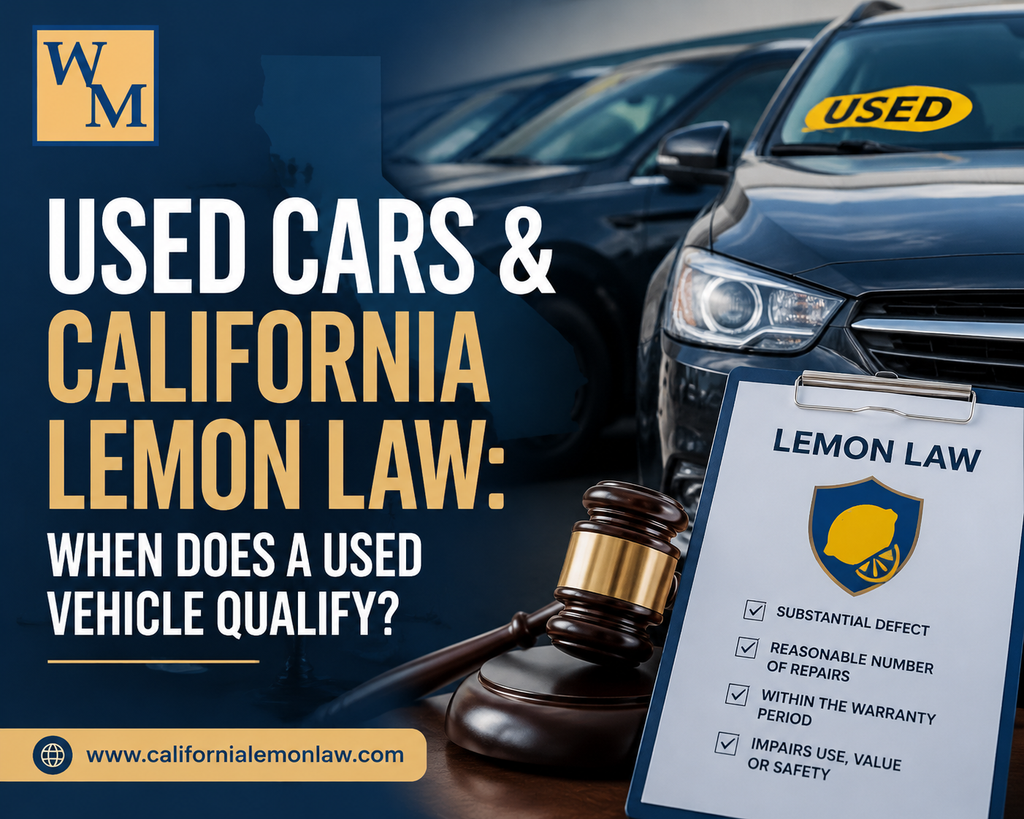
Used car dealership vehicle with California Lemon Law checklist showing when a used vehicle may qualify for lemon law protection

Used Cars & California Lemon Law: When Does a Used Vehicle Qualify?

Quick answer: California Lemon Law may protect used vehicle owners when the vehicle is still covered by a manufacturer's warranty and has experienced repeated defects affecting its use, value, or safety. Eligibility depends on warranty status, repair history, and the nature of the defect—not simply whether the vehicle is new or used. more Many used vehicle owners assume California Lemon Law only applies to brand-new cars driven off the lot. That assumption leads a lot of people to endure repeated repair visits without ever knowing they may have legal options. The reality is that certain used vehicles may qualify for protection—and understanding your warranty coverage is often the first step in figuring out where you stand. If you're unsure whether your situation may qualify, speaking with a Lemon Law attorney can help clarify your rights before you invest more time and money into repairs. Can a Used Car Qualify Under California Lemon Law? Yes—a used vehicle may qualify, depending on the circumstances. The core question is whether the vehicle is still covered by a manufacturer's warranty at the time the defects arise. Under California Lemon Law (officially the Song-Beverly Consumer Warranty Act), a vehicle must meet several conditions to potentially qualify: The vehicle must have a defect that substantially impairs its use, value, or safety The defect must be covered by a manufacturer's warranty The manufacturer or authorized dealer must have had a reasonable number of attempts to repair the defect without success Model year alone does not determine eligibility. What matters most is whether the vehicle is under a qualifying warranty and whether the repair history supports a claim. Understanding Warranty Coverage on Used Vehicles Not all warranties are created equal. The type of coverage on your used vehicle plays a significant role in whether California Lemon Law protections may apply. Factory Warranty A factory warranty—also called a manufacturer's warranty—is issued directly by the automaker and transfers with the vehicle. If a used vehicle still has remaining factory warranty coverage based on mileage and time limits, that coverage may support a used car lemon law claim. The key is that the defect must have occurred and been reported while the factory warranty was still active. Certified Pre-Owned (CPO) Coverage Certified pre-owned vehicles often include additional manufacturer-backed warranty coverage beyond the original factory warranty. The specific terms vary by manufacturer and program, but CPO coverage is generally administered by the automaker—which means it may carry similar protections as a standard factory warranty. Reviewing your CPO agreement carefully can help clarify what's covered and for how long. Dealer or Third-Party Warranties Dealer warranties and third-party service contracts are fundamentally different from manufacturer warranties. In California, these agreements are treated as service contracts or mechanical breakdown policies—not warranties in the legal sense. Because the manufacturer has no involvement in these agreements, they generally do not provide the same protections under California Lemon Law. If your vehicle is covered only by a dealer or third-party contract, a review of your specific circumstances can help determine what options may be available. Examples of Used Vehicles That May or May Not Qualify Every situation is different, but these examples may help illustrate how warranty coverage and repair history factor into eligibility. Possible Qualifying Scenarios A used vehicle purchased from a dealership that still had remaining factory warranty coverage at the time of purchase, and has since experienced repeated warranty repairs for the same defect A certified pre-owned vehicle that has been returned to the dealership multiple times for the same recurring issue under the CPO warranty A used vehicle with a documented history of multiple repair visits for a defect that substantially affects its safety or drivability Possible Non-Qualifying Scenarios A vehicle purchased through a private party with no remaining manufacturer warranty coverage A vehicle sold with only a dealer or third-party service contract, rather than a factory warranty A vehicle whose factory warranty had already expired prior to the defect being reported Does It Matter Where the Used Vehicle Was Purchased? The purchase source can affect eligibility in a few ways, though it doesn't automatically determine whether a claim exists. Private Sales Private-party transactions often come without any remaining manufacturer warranty, which can make it more difficult to pursue a lemon law claim. Without an active factory warranty, the legal framework for a claim may not apply. That said, a review of the vehicle's history and any existing warranty documentation can help determine whether any coverage remains. Out-of-State Purchases Vehicles purchased outside of California may require a closer look. Warranty coverage, registration status, and repair history can all affect available options under California law. Each case depends on its specific facts. Remaining Factory Coverage Regardless of where or how the vehicle was purchased, remaining factory warranty coverage may be a key factor. If the manufacturer's warranty was still active when the defects occurred, that coverage may be relevant to a potential claim. Documents to Gather for a Used Car Lemon Law Review Keeping thorough records strengthens any potential claim. If you believe your used vehicle may qualify, start gathering the following: Purchase agreement or sales documents Vehicle warranty information Repair orders from each service visit Service records Mileage records Communications with the dealership or manufacturer Warranty claim information Vehicle registration documents Detailed records help establish a clear timeline of repair attempts and warranty coverage—both of which are central to evaluating whether a claim may exist. Frequently Asked Questions About Used Cars and California Lemon Law Does a used car have to be a certain model year to qualify for California Lemon Law? No. Model year alone does not determine whether a used vehicle may qualify. Warranty status and repair history are the more important factors. A vehicle several years old may still qualify if it was under a manufacturer's warranty when the defects occurred and repairs were unsuccessful. Is there a mileage limit for used vehicles under California Lemon Law? There is no fixed mileage cutoff that automatically disqualifies a vehicle. However, mileage can affect whether factory warranty coverage was still active when the defects arose. Each situation depends on the specific facts and the terms of the applicable warranty. Does my vehicle need to be registered in California to qualify? Registration and the primary use of the vehicle within California may be relevant factors in a legal review. Whether California Lemon Law applies depends on the full circumstances of your situation, which a legal review can help assess. Do dealer warranties qualify the same as factory warranties under California Lemon Law? No. Dealer warranties and third-party service contracts are treated differently from manufacturer warranties under California law. These agreements are generally considered service contracts, not warranties, and do not carry the same legal protections under the California Lemon Law statute. California Lemon Law Help for Used Vehicle Owners in Carlsbad Used vehicle owners in Carlsbad, California who are dealing with repeated repairs and unresolved defects have good reason to understand their rights. Whether you purchased your vehicle from a local dealership or elsewhere in the state, warranty coverage and repair history may determine whether California Lemon Law protections apply to your situation. Consulting a Lemon Law attorney for a review of your circumstances is a practical first step—especially when repair visits continue to stack up without resolution. Find Out Whether Your Used Vehicle May Qualify If you are dealing with repeated repairs on a used vehicle, contact our team to discuss your warranty coverage, repair history, and whether California Lemon Law protections may apply. A review of your vehicle's records can help clarify your options at no cost to you.

What Los Angeles Drivers Should Know About Vehicle Buybacks

If you drive in Los Angeles and are facing ongoing car troubles that repairs just don't seem to fix, you may need to take advantage of the Lemon Law option for a vehicle buyback. more What Los Angeles Drivers Should Know About Vehicle Buybacks and the Lemon Law A vehicle buyback is when the manufacturer takes back a car after there have been repeated, unsuccessful attempts to repair a substantial defect, meaning the issue substantially impairs the vehicle's use, value, or safety. You don't need to reach a fixed number of shop visits to qualify in every case, but the courts typically consider that four or more attempts for the same problem, or thirty days or more out of service, is the tipping point. In a buyback, the manufacturer must refund your purchase price minus a reasonable mileage offset based on your miles driven before the problems piled up. That refund includes a refund of everything you paid, including sales tax, registration fees, document fees at the dealership, and any other official charges. If you financed the car, the manufacturer must also handle paying off the loan balance, too. Incidental costs, like towing or the cost of getting rental cars during repairs, are often factored in as well. You can choose between a full buyback or getting a replacement vehicle of the same model, though most people get the buyback because they don't care to take a risk that the same model will have the same problems. How the Process Works Keep a record of every repair order, invoice, and communication you have with the dealership or manufacturer. Document the dates, your mileage, and exactly what was fixed each time the vehicle went in for repairs. Then your lawyer will use all this to send a written demand to the manufacturer outlining the defects and repair history. Manufacturers often first respond by offering an inspection or settlement discussion, and your lawyer will advise you on the best steps to take depending on the response you get. If the manufacturer objects and talks stall, you can pursue arbitration, and many cases settle before either step when the evidence is clear and a lawyer has laid it out in a convincing way. Expect the manufacturer to also cover reasonable attorney fees if you win, so it's in your best interests to get a lawyer if you don't get a prompt, proper response to your problem. The whole refund process typically closes within a few weeks, once you've settled with the manufacturer and the paperwork clears. Talk to an Experienced LA Attorney Today Vehicle buybacks give you a way to get relief when a car fails to deliver and a manufacturer has sold you something that's defective. If you've been sold a lemon, reach out to the Law Offices of William R. McGee in Los Angeles today to speak directly with an attorney. We also serve clients in San Diego, San Francisco, Glendale, Irvine, Sacramento, Carlsbad, and Oxnard, CA.

How Many Repair Visits Does It Take Before You Can Demand a Refund?

If your vehicle won't stay fixed despite repeated trips to the shop, California's Lemon Law could help you. The laws don't set a specific number of attempts, so it's a good idea to talk with a lawyer who has experience in this area. A lawyer will be able to tell you how the laws are interpreted and applied in cases like yours. more Lemon Law Repair Attempts The law creates a presumption that a reasonable number of repair attempts have occurred if certain conditions are met within the first 18 months or 18,000 miles of the vehicle's life, whichever comes first. Once that presumption kicks in, the burden shifts, and now the manufacturer must either replace the vehicle or refund the purchase price, and you may choose which. How It Works If you've had four or more unsuccessful repair attempts by the manufacturer, or its authorized agents, for the same problem, this triggers the presumption. In addition, you must have notified the manufacturer directly at least once about the ongoing issue. Each visit counts only if it addresses that specific problem and the repair does not permanently resolve it. If the defect you're having repaired is so serious it could cause death or serious bodily injury if the vehicle is driven, such as if the brakes don't work properly under certain circumstances, then you only need two or more unsuccessful repair attempts, plus that same direct notification to the manufacturer, to trigger the presumption. Other Ways to Qualify The vehicle also qualifies under the presumption if it has been out of service for repairs for any warranty-covered issues (not just the same one over and over) for a cumulative total of more than 30 calendar days. These days do not need to run consecutively, either. All the time you've spent waiting for parts or waiting for the shop to schedule the work counts toward the total, as long as the vehicle remains unavailable to you because of the repair process. California Requirements for Refunds State warranty rules require you to keep all the records from every service visit. The repair orders should list the exact complaint you reported, the date you dropped off and picked up the vehicle, the odometer reading at drop-off, and a clear description of what work was performed. You'll also need proof that you notified the manufacturer, so it's best to send a letter by certified mail to the address listed in your owner's manual or warranty booklet and keep the return receipt. Your Rights Under the Law Once you've triggered the presumption, you'll need to go to arbitration, and if the arbiter agrees that the demands of the Lemon Law presumption have been met, you now have the right to demand either a replacement vehicle of the same make and model or a refund of the purchase price. If you've reached this point with your vehicle, contact us today at the Law Offices of William R. McGee in Carlsbad, CA for a no-cost review of your repair history. We also have offices in Los Angeles, Irvine, San Diego, San Francisco, Glendale, Oxnard, and Sacramento.