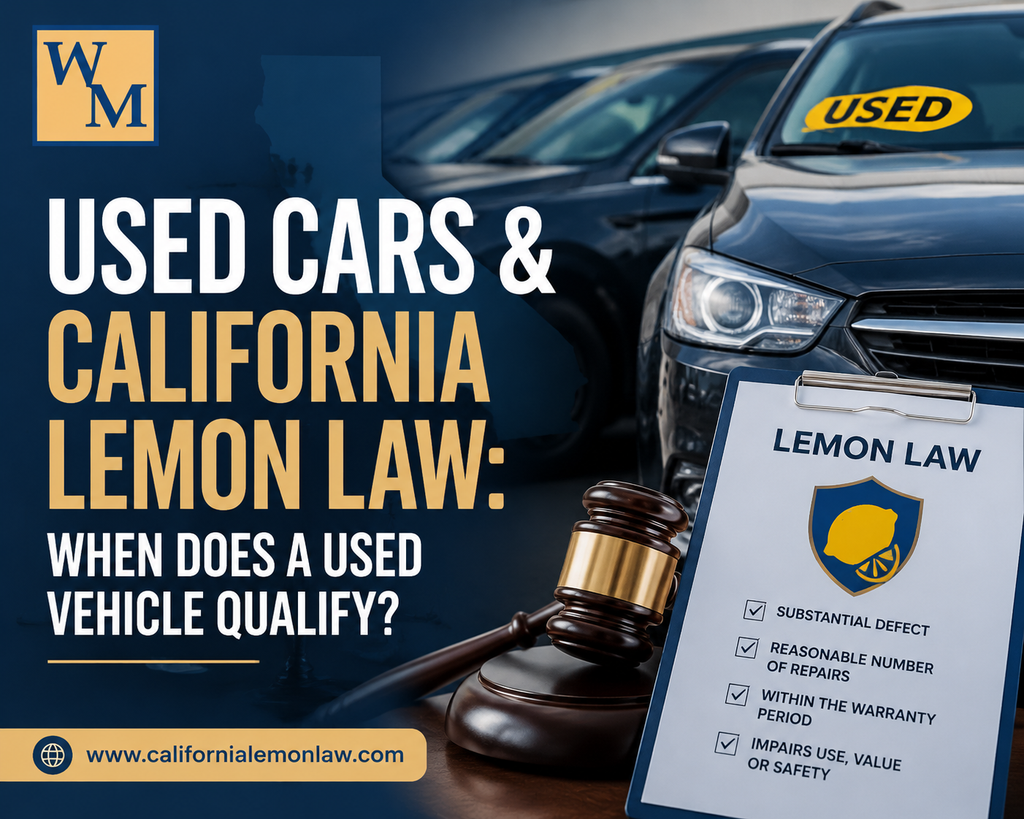
Quick answer: California Lemon Law may protect used vehicle owners when the vehicle is still covered by a manufacturer's warranty and has experienced repeated defects affecting its use, value, or safety. Eligibility depends on warranty status, repair history, and the nature of the defect—not simply whether the vehicle is new or used. Many used vehicle owners assume California Lemon Law only applies to brand-new cars driven off the lot. That assumption leads a lot of people to endure repeated repair visits without ever knowing they may have legal options. The reality is that certain used vehicles may qualify for protection—and understanding your warranty coverage is often the first step in figuring out where you stand. If you're unsure whether your situation may qualify, speaking with a Lemon Law attorney can help clarify your rights before you invest more time and money into repairs. Can a Used Car Qualify Under California Lemon Law? Yes—a used vehicle may qualify, depending on the circumstances. The core question is whether the vehicle is still covered by a manufacturer's warranty at the time the defects arise. Under California Lemon Law (officially the Song-Beverly Consumer Warranty Act), a vehicle must meet several conditions to potentially qualify: The vehicle must have a defect that substantially impairs its use, value, or safety The defect must be covered by a manufacturer's warranty The manufacturer or authorized dealer must have had a reasonable number of attempts to repair the defect without success Model year alone does not determine eligibility. What matters most is whether the vehicle is under a qualifying warranty and whether the repair history supports a claim. Understanding Warranty Coverage on Used Vehicles Not all warranties are created equal. The type of coverage on your used vehicle plays a significant role in whether California Lemon Law protections may apply. Factory Warranty A factory warranty—also called a manufacturer's warranty—is issued directly by the automaker and transfers with the vehicle. If a used vehicle still has remaining factory warranty coverage based on mileage and time limits, that coverage may support a used car lemon law claim. The key is that the defect must have occurred and been reported while the factory warranty was still active. Certified Pre-Owned (CPO) Coverage Certified pre-owned vehicles often include additional manufacturer-backed warranty coverage beyond the original factory warranty. The specific terms vary by manufacturer and program, but CPO coverage is generally administered by the automaker—which means it may carry similar protections as a standard factory warranty. Reviewing your CPO agreement carefully can help clarify what's covered and for how long. Dealer or Third-Party Warranties Dealer warranties and third-party service contracts are fundamentally different from manufacturer warranties. In California, these agreements are treated as service contracts or mechanical breakdown policies—not warranties in the legal sense. Because the manufacturer has no involvement in these agreements, they generally do not provide the same protections under California Lemon Law. If your vehicle is covered only by a dealer or third-party contract, a review of your specific circumstances can help determine what options may be available. Examples of Used Vehicles That May or May Not Qualify Every situation is different, but these examples may help illustrate how warranty coverage and repair history factor into eligibility. Possible Qualifying Scenarios A used vehicle purchased from a dealership that still had remaining factory warranty coverage at the time of purchase, and has since experienced repeated warranty repairs for the same defect A certified pre-owned vehicle that has been returned to the dealership multiple times for the same recurring issue under the CPO warranty A used vehicle with a documented history of multiple repair visits for a defect that substantially affects its safety or drivability Possible Non-Qualifying Scenarios A vehicle purchased through a private party with no remaining manufacturer warranty coverage A vehicle sold with only a dealer or third-party service contract, rather than a factory warranty A vehicle whose factory warranty had already expired prior to the defect being reported Does It Matter Where the Used Vehicle Was Purchased? The purchase source can affect eligibility in a few ways, though it doesn't automatically determine whether a claim exists. Private Sales Private-party transactions often come without any remaining manufacturer warranty, which can make it more difficult to pursue a lemon law claim. Without an active factory warranty, the legal framework for a claim may not apply. That said, a review of the vehicle's history and any existing warranty documentation can help determine whether any coverage remains. Out-of-State Purchases Vehicles purchased outside of California may require a closer look. Warranty coverage, registration status, and repair history can all affect available options under California law. Each case depends on its specific facts. Remaining Factory Coverage Regardless of where or how the vehicle was purchased, remaining factory warranty coverage may be a key factor. If the manufacturer's warranty was still active when the defects occurred, that coverage may be relevant to a potential claim. Documents to Gather for a Used Car Lemon Law Review Keeping thorough records strengthens any potential claim. If you believe your used vehicle may qualify, start gathering the following: Purchase agreement or sales documents Vehicle warranty information Repair orders from each service visit Service records Mileage records Communications with the dealership or manufacturer Warranty claim information Vehicle registration documents Detailed records help establish a clear timeline of repair attempts and warranty coverage—both of which are central to evaluating whether a claim may exist. Frequently Asked Questions About Used Cars and California Lemon Law Does a used car have to be a certain model year to qualify for California Lemon Law? No. Model year alone does not determine whether a used vehicle may qualify. Warranty status and repair history are the more important factors. A vehicle several years old may still qualify if it was under a manufacturer's warranty when the defects occurred and repairs were unsuccessful. Is there a mileage limit for used vehicles under California Lemon Law? There is no fixed mileage cutoff that automatically disqualifies a vehicle. However, mileage can affect whether factory warranty coverage was still active when the defects arose. Each situation depends on the specific facts and the terms of the applicable warranty. Does my vehicle need to be registered in California to qualify? Registration and the primary use of the vehicle within California may be relevant factors in a legal review. Whether California Lemon Law applies depends on the full circumstances of your situation, which a legal review can help assess. Do dealer warranties qualify the same as factory warranties under California Lemon Law? No. Dealer warranties and third-party service contracts are treated differently from manufacturer warranties under California law. These agreements are generally considered service contracts, not warranties, and do not carry the same legal protections under the California Lemon Law statute. California Lemon Law Help for Used Vehicle Owners in Carlsbad Used vehicle owners in Carlsbad, California who are dealing with repeated repairs and unresolved defects have good reason to understand their rights. Whether you purchased your vehicle from a local dealership or elsewhere in the state, warranty coverage and repair history may determine whether California Lemon Law protections apply to your situation. Consulting a Lemon Law attorney for a review of your circumstances is a practical first step—especially when repair visits continue to stack up without resolution. Find Out Whether Your Used Vehicle May Qualify If you are dealing with repeated repairs on a used vehicle, contact our team to discuss your warranty coverage, repair history, and whether California Lemon Law protections may apply. A review of your vehicle's records can help clarify your options at no cost to you.
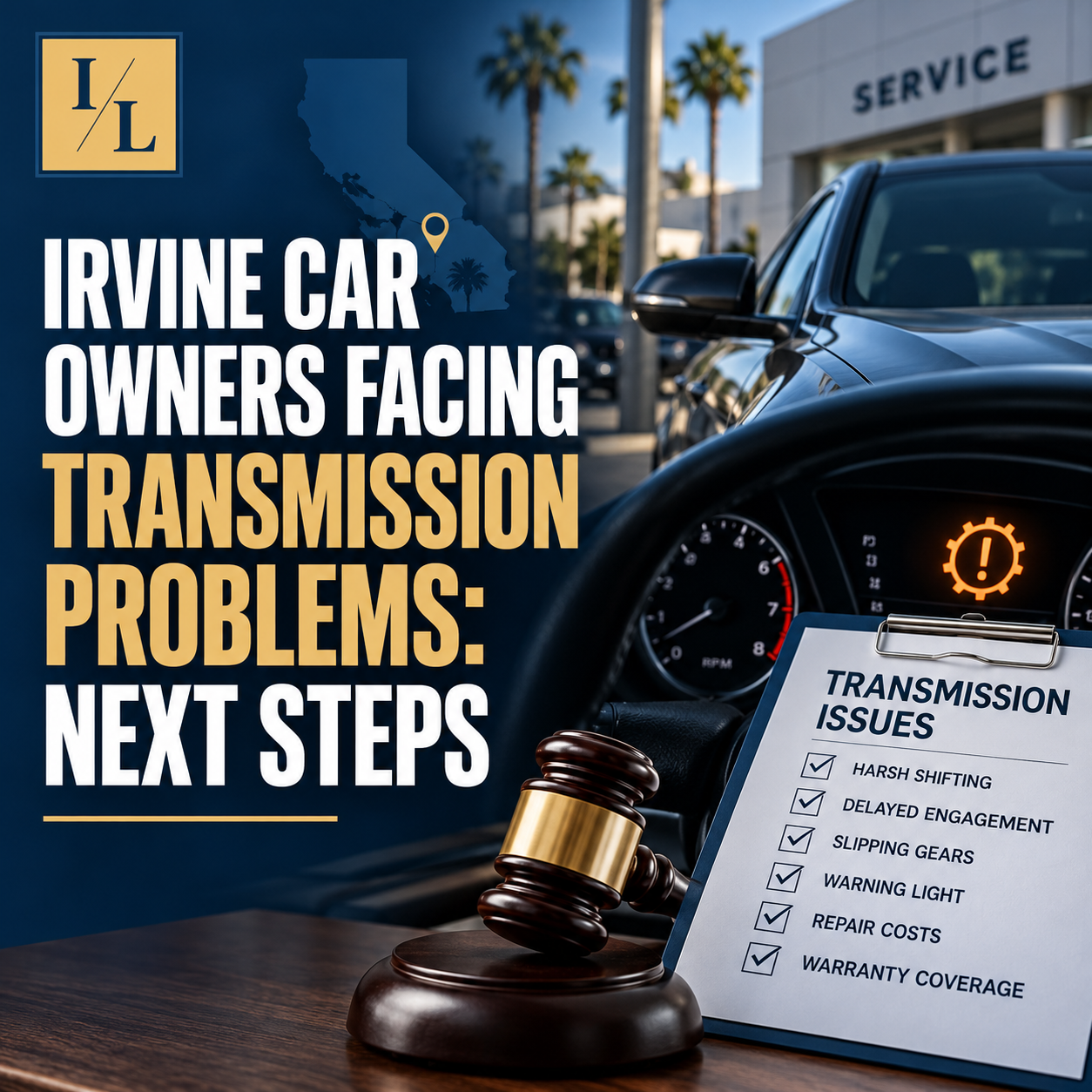
Irvine Car Owners Facing Transmission Problems: Next Steps
Is your transmission slipping, shuddering, or dropping into reduced-power mode, and has a visit to the dealer failed to fix it? If so, you do have options. Defective car protections under California lemon laws give you recourse in this situation, and a local Irvine attorney can help you access all your rights. When Your Vehicle Has Transmission Problems If you bought or leased a new vehicle with a written warranty, California law requires that the manufacturer, through its dealer, repair the car so that it matches that warranty. Service has to start within a reasonable time of the problem being flagged up, and it has to be finished within 30 days unless you agree to more time or the delay is outside the manufacturer's control. If the car is not safe to drive in, you can give written notice instead of delivering it, and the manufacturer has to arrange transport to get it fixed. Once it's declared fixed, if the issue comes back, you are no longer waiting on another diagnosis. You can immediately ask the manufacturer to replace the car or pay you back. An unrepaired warranty defect is the manufacturer's problem, not yours. What Counts for Reimbursement or Replacement? A defect qualifies when it substantially impairs the car's use, value, or safety, and you don't have to show that the car dies on every trip or anything like that. A shifting problem that makes the car unreliable in traffic is precisely the kind of defect the statute treats as a substantial impairment. Working With Your Lawyer to Access Defective Car Protections You'll need the ordinary paperwork from each dealer visit you've made while the car was under warranty. Ask for a repair order that shows the date in, the date out, the mileage at both ends, the complaint in your own words, and the work that was done. Any days the car sat waiting for a part to arrive count towards the 30-day total, so keep the loaner agreement and any communications you've had with the service advisor. Your lawyer will help you send the right note to the manufacturer. This should start with the first repair attempt, putting them on notice that there's a potential issue. Once they've failed to fix the problem, you can notify them that you're making a claim under the law and provide evidence that they've failed in their obligations to you in regard to providing a serviceable car. Replace or Refund? The manufacturer cannot force a replacement on you. If you take the replacement, it comes with all the warranties that normally come with a new car, and the manufacturer pays the tax, license, and registration on it, along with incidental damages. If you take restitution, the amount is the actual price you paid or still owe, including transportation charges and manufacturer-installed options, plus sales tax, license fees, and registration, together with incidental damages, minus a use offset. Talk to an Irvine Lemon Law Attorney If you're not getting the response you should out of your vehicle's manufacturer, contact the Law Offices of William R. McGee for a free case evaluation. We have 36 years of experience winning lemon law cases throughout the state of California.